
Your Screenplay Is a Database
Every scene heading, character name, and action line is structured data waiting to be parsed. Here's what changes when you treat it that way.
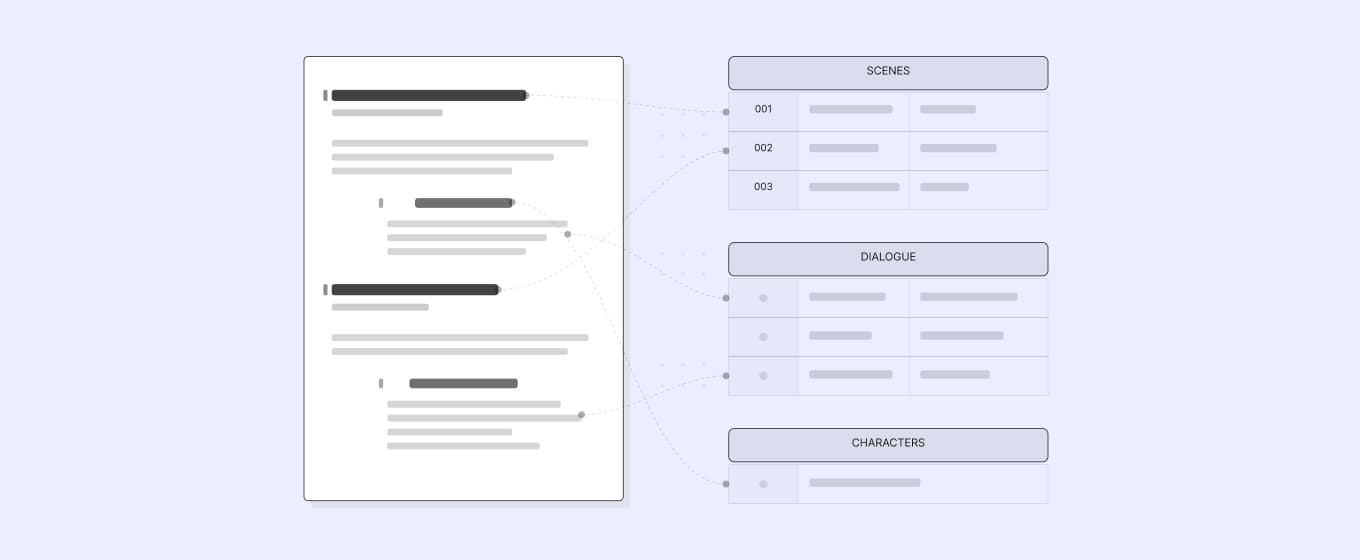
A screenplay is the most information-dense document in all of production. In roughly 100 pages, it encodes every character, every location, every relationship, every prop, every visual effect, and every emotional beat of a film.
And yet for most of the industry's history, that information has lived as inert text — readable by humans, invisible to systems.
The Hidden Structure
Feature screenplays follow a rigid grammar. INT. vs EXT. Scene headings establish location and time of day. Character cues precede every line of dialogue. Parentheticals annotate performance. Action lines describe the visual world.
This isn't stylistic convention. It's a protocol. One that, when parsed correctly, unlocks everything a production needs to know before principal photography begins.
What Changes When You Parse It
When you treat a screenplay as a database rather than a document, a few things happen immediately:
Characters become records. Every appearance logged. Scene count, dialogue line count, co-scene relationships — all derivable from the text.
Locations become a shooting matrix. Every INT/EXT pair tells you something about setup costs, daylight requirements, and schedule clustering potential.
Dialogue becomes tone data. The ratio of action to dialogue per scene, the vocabulary complexity per character, the emotional arc mapped across acts — these are measurable.
Visual complexity becomes a budget signal. An action line reading "The convoy explodes across the bridge" means something different to a line producer than "She pours coffee." Both are one sentence. Neither is weighted the same.
The 14-Deliverable Problem
A standard production requires at least 14 documents before a shoot: coverage, character breakdowns, shooting schedule, one-liner, budget topline, script notes, VFX inventory, location list, prop list, wardrobe breakdown, and more.
Each of these is currently produced manually, by different departments, often from different reads of the same source document.
Prescene reads once and produces all 14.
That's not automation for its own sake. It's the same structural analysis that experienced coordinators have always done — just made instantaneous, consistent, and queryable.
What This Means for Writers
If you're a writer, this probably sounds like production infrastructure. It is. But it changes something for you too.
When your script is a living database, notes become specific. "The second act drags" becomes "scenes 42–61 average 1.3 minutes of screen time per page with no location changes." That's actionable.
When your script is a database, coverage is no longer a human bottleneck. It's generated, structured, and available the moment the PDF lands.
The screenplay doesn't change. What changes is everything downstream.
Want to see Prescene on your own script?
Currently in private beta — accepting partners across studios, writers' rooms, and AI labs.