

A practical script coverage template and rubric
Use a clear coverage template for synopsis, evaluation, scorecard, evidence, verdict, and next action. Adapt the rubric to the decision your team owns.
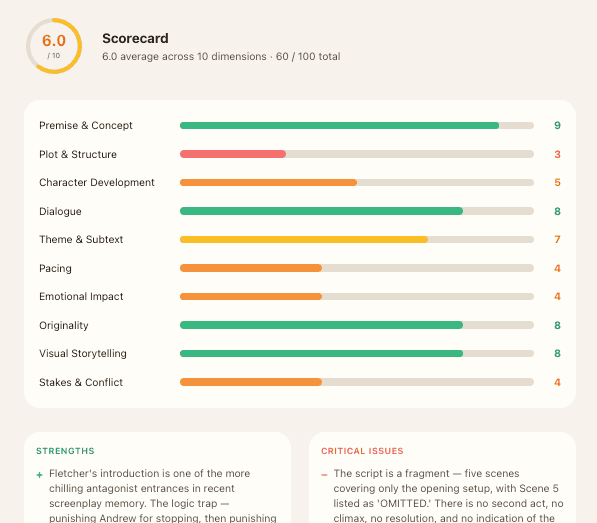
A script coverage template should make a reader's reasoning easier to inspect. It should not force every screenplay into the same taste. The structure creates shared questions while the written evaluation preserves judgment.
Use the template below as a starting point. Remove any section that does not serve your decision. Add company-specific questions only when someone will act on the answer.
Header and source
TITLE:
WRITER:
FORMAT:
GENRE:
PAGE COUNT:
DRAFT / SOURCE VERSION:
DATE RECEIVED:
DATE COVERED:
READER:
PURPOSE: submission / development / writer notes / education
The source version is essential. A report without a draft label can create expensive confusion later.
Logline
Write one or two sentences that identify the protagonist, goal, central obstacle, and stakes. A logline tests whether the dramatic engine can be stated clearly. It is not a verdict on whether the script is good.
Synopsis
Summarize the complete story, including the ending. Preserve cause and effect. Name the decisions that change the plot. Avoid reviewing the script inside the synopsis.
For a feature, one to two pages is often enough for an internal first read. For episodic work, identify the series engine and what the episode contributes to it.
Evaluation rubric
Use a small scale with written anchors. Five points are usually easier to calibrate than one hundred.
| Score | Working meaning |
|---|---|
| 1 | Materially unclear or not yet functioning for its intended purpose |
| 2 | Some working elements, with major development needs |
| 3 | Functional foundation, with meaningful strengths and weaknesses |
| 4 | Strong execution with specific development opportunities |
| 5 | Distinctive execution that supports the intended decision |
Score only the dimensions your team can define:
- Premise and story engine.
- Plot and cause.
- Character and agency.
- Dialogue and voice.
- Structure and pace.
- Tone and genre execution.
- Theme and emotional effect.
- Format-specific execution.
For every score, add two pieces of evidence: one supporting strength and one limitation or open question. A score without evidence is hard to audit and harder to discuss with a writer.
Written evaluation
Organize the written notes around the highest-leverage questions rather than repeating every score.
WHAT THE SCRIPT IS TRYING TO DO:

WHAT IS WORKING:
- Claim:
  Scene evidence:
  Why it matters:

PRIMARY DEVELOPMENT QUESTION:
- Claim:
  Scene evidence:
  Tradeoff:

CHARACTER AND RELATIONSHIP NOTES:

STRUCTURE AND PACE NOTES:

FORMAT / MARKET CONTEXT PROVIDED BY THE READER:

UNCERTAINTIES OR SECOND-READ QUESTIONS:
Separate screenplay evidence from external context. If the reader knows that a buyer is seeking contained thrillers, label that as buyer context rather than pretending it came from the pages.
Verdict
If your organization uses Pass, Consider, and Recommend, define the terms.
- Pass: Do not advance for the current purpose.
- Consider: Advance to a second read or discussion because the strengths or fit warrant more attention.
- Recommend: Advance with a clear rationale and an owner for the next step.
The verdict is relative to the purpose. A Pass for one company's slate can still be a strong writing sample. A Recommend should not mean "perfect." It means the reader can defend advancing the material.
Next action
End with an operational next step:
- Decline with reason code.
- Assign a second reader.
- Request a revision.
- Prepare for a development meeting.
- Share with a named decision-maker.
- Compare against another submission.
Calibrate the rubric
Before using the template at volume, have several readers cover the same small set of scripts. Compare the reasoning, not only the numbers. Discuss where the rubric created different interpretations and revise the anchors.
Repeat the exercise periodically. A stable form does not guarantee a stable reading culture.
The goal of a template is not uniform taste. It is legible judgment. Another person should be able to understand what the reader saw, inspect the evidence, and decide whether to agree.
Compare the template with a complete report
Run Coverage on one script and inspect how the synopsis, scorecard, verdict, and rationale work together.