

How to write script coverage that supports a decision
Write useful script coverage with a clear audience, concise synopsis, evidence-led analysis, consistent rubric, and decision-ready recommendation.
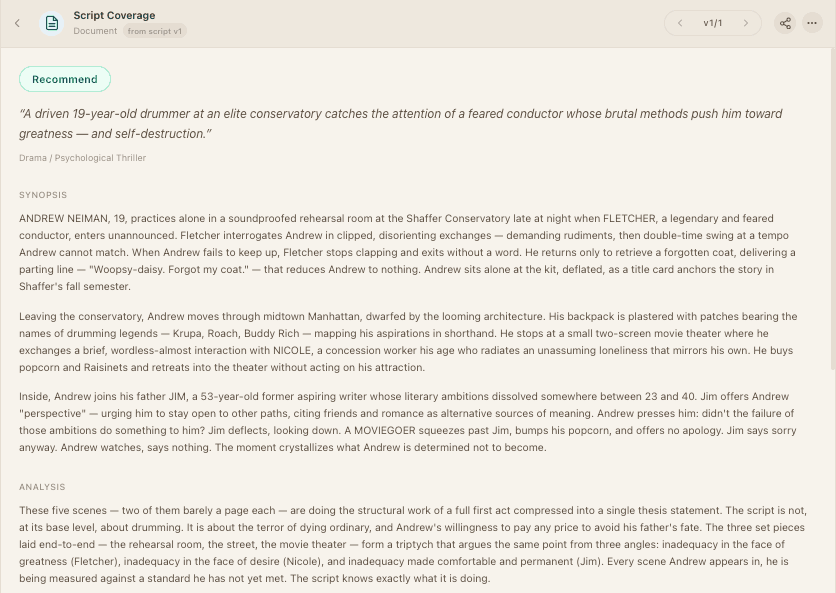
Script coverage is a decision document built from a screenplay. It usually combines project facts, a synopsis, analysis, a scoring rubric, and a recommendation. Good coverage lets a busy reader understand both the conclusion and the evidence behind it.
The format should follow the decision. An agency reader may emphasize roles and packaging. A producer may need execution risks and audience fit. A writer may need revision priorities. Ask who will read the report and what they must decide before choosing sections or scores.
A practical coverage structure
Use a stable order so reports remain comparable:
- Project snapshot: title, writer, format, genre, page count, logline, and exact draft.
- Recommendation: pass, consider, recommend, or the organization's own rubric, with a short rationale.
- Synopsis: the complete story, including the ending.
- Analysis: premise, structure, character, dialogue, tone, pacing, and audience or market considerations.
- Scorecard: category scores defined by a consistent scale.
- Strengths and risks: the qualities to protect and the problems that affect the decision.
- Next steps: revision priorities, internal follow-up, or diligence questions.
Do not hide the recommendation until the last page. State it early, then earn it.
Write the synopsis before the evaluation
A synopsis proves that the reader understood the causal chain. Include the ending and the choices that produce it. Avoid scene-by-scene transcription, praise, or criticism in this section.
For a fictional harbor thriller, a concise synopsis would establish that investigator Mara finds a falsified cargo ledger, learns her partner Deck helped conceal it, and chooses to expose both the scheme and their alliance at a public hearing. That causal line gives the later character and structure notes a shared reference point.
Make every major note evidence-led
Use four parts:
- Observation: what the screenplay is doing.
- Evidence: the scene, sequence, or recurring pattern.
- Consequence: how it affects clarity, tension, character, or the audience experience.
- Direction: the problem the next draft should solve.
Example:
Mara's final accusation feels underprepared because she learns the decisive fact off-page between the yard pursuit and the hearing. The missing discovery weakens both her agency and the climax. Let her obtain or infer that fact through a costly choice before the hearing.
The note diagnoses the effect without dictating exact dialogue.
Use scores that mean the same thing each time
Define the scale before using it. A 7 in character should represent the same threshold across readers and projects. Pair every score with a rationale, because the number alone cannot explain the material.
When multiple readers contribute, calibrate with sample scripts and discuss disagreements. Consistency is not identical opinion. It is shared criteria and visible reasoning.
Separate craft, market context, and production risk
A strong screenplay can be expensive to produce. A marketable premise can be weakly executed. A beautifully written script can be wrong for a specific mandate. Keep those claims separate so one does not masquerade as another.
Market observations should be current, qualified, and specific to the decision. Avoid promising commercial performance. Production observations from the page are inputs for specialists, not a final budget, schedule, legal review, or safety plan.
Compare coverage across screenplay versions
A good coverage system should not stop at one report. It should preserve which version produced each result, accept the follow-up draft as a new version, and make revision progress visible. Use the same evidence discipline described in the screenplay-draft comparison guide.
Compare:
- Added, removed, and rewritten scenes.
- Character choices and relationship turns.
- Whether the stated revision goal was achieved.
- Category score movement and the rationale behind it.
- Claims in the old report that are now stale.
A structure score rising from 6 to 8 matters only if the comparison explains why. Perhaps the new draft lets Mara discover the ledger herself and makes that choice cause the final hearing. The score is a signal; the version-grounded evidence is the insight.
Final quality check
Before sharing, confirm that:
- The title, writer, page count, and version are correct.
- The synopsis includes the ending and contains no evaluation.
- Every major criticism has screenplay evidence.
- Scores match the written rationale.
- The recommendation matches the intended reader's decision.
- Revision suggestions protect the script's demonstrated strengths.
- Sensitive files and reports are shared only with the intended people.
Coverage is useful when another person can make a better decision without rereading the screenplay immediately, then return to the source when they need to inspect the evidence.
Use what script coverage includes to align the report with its reader, then apply the AI coverage-tool framework when testing full-script support, privacy, exports, and follow-up Coverage across versions.
Connect Coverage to the screenplay version
Run Coverage on a draft, return for follow-up Coverage on the next version, compare what changed, and measure score movement over time.