

The six basic story arcs and how to use them in a screenplay
Six recurring emotional shapes can help writers inspect how a screenplay rises, falls, and changes. Use them as diagnostic maps, not story formulas.
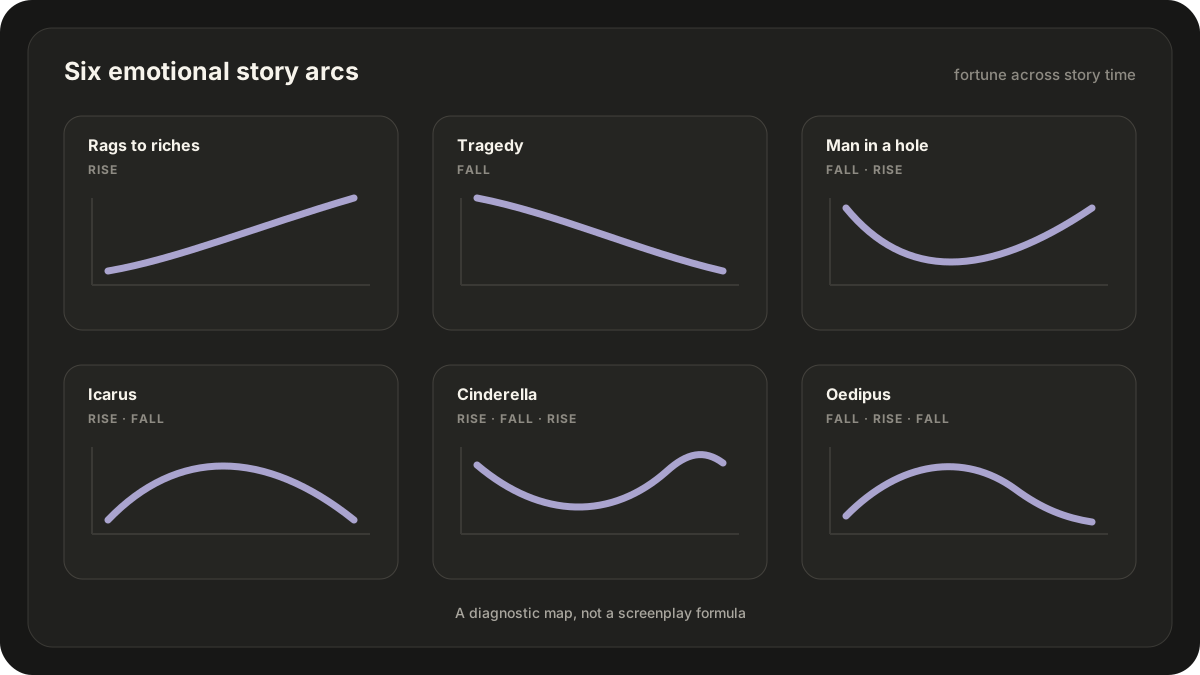
The six basic story arcs are recurring patterns of rising and falling emotional fortune: rise, fall, fall-rise, rise-fall, rise-fall-rise, and fall-rise-fall. They are often called Rags to riches, Tragedy, Man in a hole, Icarus, Cinderella, and Oedipus.
These shapes describe the emotional trajectory of a story at a high level. They do not prescribe acts, beats, genre, or quality. A writer can use an arc to see where the audience's experience changes, then return to the screenplay to understand which choices and scenes caused that movement.
Where the six arcs come from
Kurt Vonnegut popularized the idea that stories could be drawn as simple shapes, with time on one axis and fortune on the other. A 2016 open-access study in EPJ Data Science tested related ideas across 1,327 works from Project Gutenberg. Using sentiment analysis and three different computational methods, the researchers found broad support for six recurring emotional trajectories.
The study examined rolling language sentiment in mostly literary texts. It did not prove that every screenplay belongs to one shape, that one arc causes commercial success, or that sentiment is the same as plot. The useful takeaway is narrower: complex stories can contain recognizable patterns of emotional movement. Read the study and methodology.
The six shapes at a glance
| Arc | Shape | Practical screenplay question |
|---|---|---|
| Rags to riches | Rise | What choices create sustained improvement in the character's condition? |
| Tragedy | Fall | Which decisions make the loss increasingly difficult to reverse? |
| Man in a hole | Fall, then rise | What puts the character in trouble, and what earns the recovery? |
| Icarus | Rise, then fall | Which success creates the conditions for the reversal? |
| Cinderella | Rise, fall, then rise | What is gained, lost, and regained with a meaningful difference? |
| Oedipus | Fall, rise, then fall | Why does the apparent recovery make the final loss sharper? |
The names are shorthand. The causal movement matters more than the label.
1. Rags to riches: sustained rise
The central experience moves from worse to better. The rise can involve status, safety, belonging, knowledge, power, or self-respect rather than money.
The weak version is an uninterrupted reward sequence. The stronger version makes each improvement depend on a choice, cost, or new responsibility. Ask whether the final condition was earned by the protagonist's changing behavior.
2. Tragedy: sustained fall
The character's condition deteriorates across the story. A tragedy becomes more than a sequence of bad events when the character's decisions help close off safer alternatives.
Track the last moment at which a different choice could have changed the outcome. If the fall feels arbitrary, the screenplay may need a clearer relationship between flaw, pressure, action, and consequence.
3. Man in a hole: fall and recovery
The story begins near a stable condition, drops into trouble, and climbs out. This shape appears in many genres because it describes a basic dramatic promise: disruption, struggle, and a changed return.
Recovery should not simply restore the opening. The character may regain safety while losing trust, solve the external problem while accepting a harder truth, or return home with a new responsibility.
4. Icarus: rise and fall
Early success produces a later reversal. The rise matters because it increases what can be lost and may expose the belief or behavior that causes the fall.
Look for the point at which achievement becomes overreach. If success and collapse are unrelated, the shape will feel like two stories placed beside each other.
5. Cinderella: rise, fall, and renewed rise
The character gains a better condition, loses it, then rises again. The second rise should not be a duplicate of the first. It usually carries new knowledge, agency, or cost.
Compare the two high points. The first may depend on luck, approval, or borrowed power. The second becomes dramatically stronger when the protagonist can now create or choose the condition for themselves.
6. Oedipus: fall, recovery, and final fall
An early loss is followed by apparent recovery, then a deeper reversal. The middle rise creates hope or false control, which gives the ending more force.
The final fall works when the recovery helped reveal, accelerate, or make possible the last consequence. If the ending arrives from an unrelated event, the emotional pattern may be visible without being causally satisfying.
How to map a screenplay's emotional arc
Start with the beat sheet or a short scene list. Then:
- Choose the point of view. Map the protagonist, a relationship, or the audience's knowledge. Do not switch measures halfway through.
- Define fortune for this story. It might mean safety, intimacy, public standing, control, or proximity to a goal.
- Mark five to eight consequential turns. Use choices and reversals, not every scene.
- Assign direction. For each turn, record whether the condition rises, falls, or remains unstable.
- Explain the cause. Name the action or discovery that creates the movement.
- Compare the ending with the opening. State what changed beyond the final plot result.
A worked example
Consider a fictional harbor thriller about Mara, an investigator tracing falsified cargo records.
| Turn | Story event | Fortune movement |
|---|---|---|
| Stable authority | Mara leads a routine port audit | Baseline |
| Missing ledger | Her supervisor removes her from the case | Fall |
| Private evidence | She finds records linking the scheme to a contractor | Rise |
| Partner implicated | Deck takes the evidence and blocks her inquiry | Fall |
| Public hearing | Mara reconstructs the scheme from another source | Rise |
| Personal exposure | Winning the case reveals her own misconduct | Mixed ending |
The broad pattern resembles fall-rise-fall-rise, but the label is not the diagnosis. The useful questions are why Deck's betrayal follows Mara's earlier choices, whether the second recovery is earned, and what the mixed ending means for her relationship and identity.
Use the screenplay-analysis framework to test those causes at scene level. Use a character breakdown when the external plot rises while the character's internal condition falls.
Story arc, plot structure, and character arc are different
- Emotional arc tracks rising and falling fortune or sentiment.
- Plot structure tracks the sequence of disruptions, decisions, reversals, and consequences.
- Character arc tracks changes in belief, strategy, identity, or commitment.
The three can move differently. A protagonist can win the external case while losing a relationship. A bleak plot can produce an internal rise if the character finally acts with integrity. Separating the layers prevents one line on a graph from flattening the screenplay.
Use arcs as a diagnostic, not a formula
A screenplay may contain nested arcs, an ensemble may distribute movement across several characters, and an episode may rise while the season falls. Some stories deliberately resist a clean resolution.
Do not rewrite a distinctive screenplay merely to make the graph smoother. Use the shape to locate a question: a recovery without a cause, two reversals doing the same job, a climax that does not change the character's condition, or a relationship moving against the plot.
When the next draft is ready, compare it with the earlier version. A draft comparison can show whether the intended turn moved, disappeared, or gained the scene-level support it needed. The graph suggests where to look. The screenplay provides the evidence.
Test the shape against the screenplay
Use Prescene to inspect the scenes, choices, relationships, and version changes behind a story-level diagnosis.