

What is a character breakdown?
A character breakdown turns script evidence into a practical profile of role, relationships, goals, arc, casting facts, and production needs.
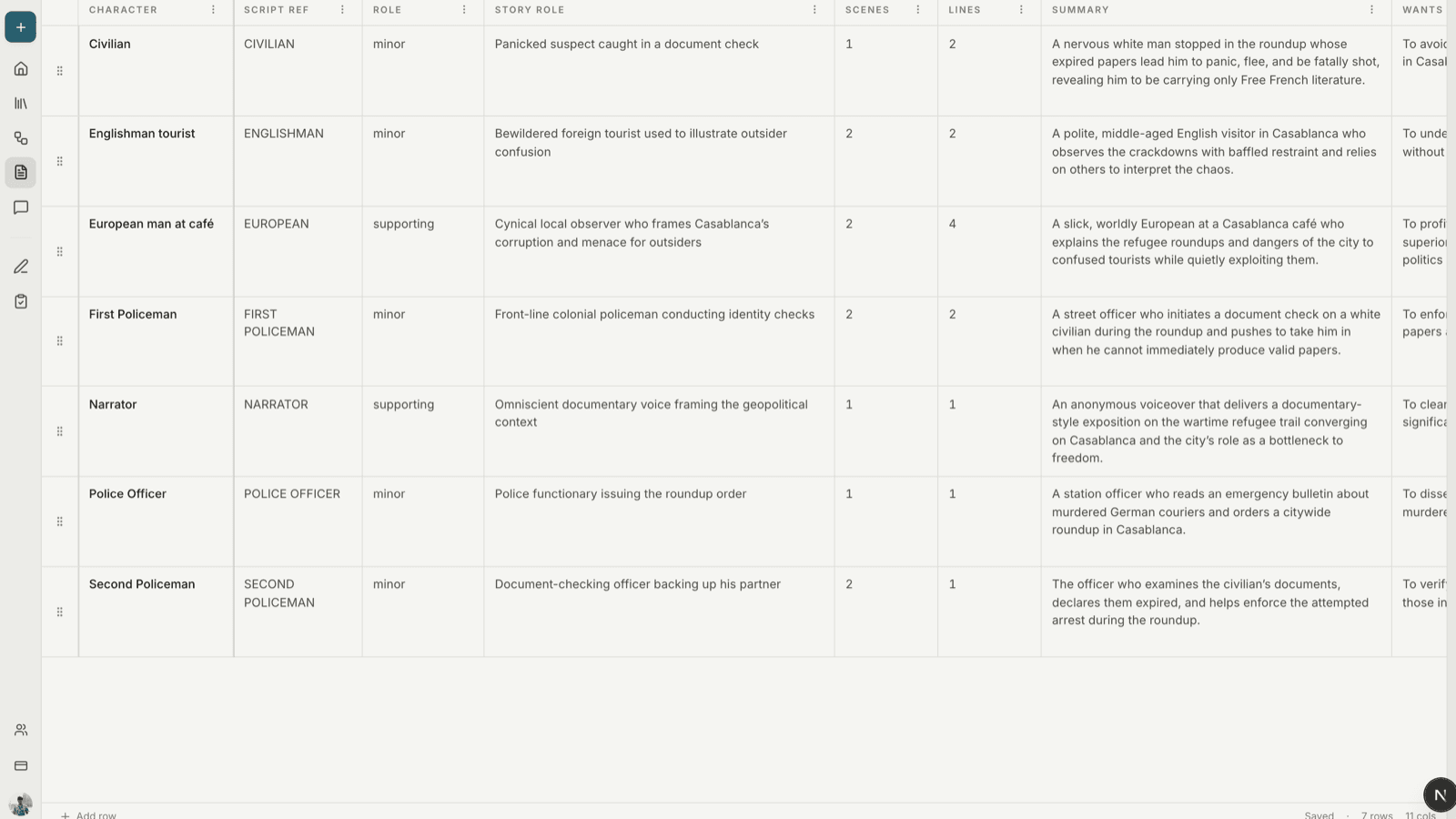
A character breakdown is a structured profile of a character's function in a screenplay. It can support development, casting, continuity, or production, depending on what the team needs to decide.
The term is used loosely. A casting breakdown may focus on playable facts and role size. A development breakdown may focus on goal, conflict, relationships, and arc. A production breakdown may need scenes, wardrobe, props, and special requirements. Start by naming the job.
The three common breakdowns
Development character breakdown
Use this to discuss how the character works in the story.
- Story role and point of view.
- External goal and immediate objectives.
- Internal need, fear, or contradiction.
- Important relationships.
- Choices that drive the plot.
- Arc across the current script or series.
- Scenes that provide the strongest evidence.
Casting character breakdown
Use this to communicate the role to actors and representatives. Include only information the production is prepared and permitted to specify.
- Character name and role size.
- Playing age or story-relevant age.
- Character description grounded in the material.
- Skills, language, accent, movement, or performance requirements.
- Schedule or episode information when known.
- Submission instructions and approved production details.
Avoid turning personality into a list of appearance requirements. Separate what the story requires from assumptions that accumulated around the role.
Production character breakdown
Use this to prepare departments and schedules.
- Scene appearances.
- Day or night and interior or exterior patterns.
- Costume, hair, makeup, prosthetic, stunt, or intimacy requirements.
- Props, vehicles, animals, and special equipment connected to the character.
- Continuity changes such as injuries, disguises, or time jumps.
A development template
CHARACTER NAME:
ALIASES / PRIOR NAMES:
STORY ROLE:
FIRST APPEARANCE:

EXTERNAL GOAL:
INTERNAL NEED:
PRIMARY CONFLICT:
KEY CONTRADICTION:

IMPORTANT RELATIONSHIPS:
- Character:
  Starting state:
  Major change:
  Current state:

ARC BY TURN:
1.
2.
3.

DEFINING CHOICES:
- Choice:
  Scene evidence:
  Consequence:

OPEN QUESTIONS:
SOURCE VERSION:
Build from evidence, not adjectives
"Brave, witty, and guarded" sounds precise but may conceal weak analysis. A useful breakdown connects a trait to behavior.
Instead of writing "Mara is distrustful," record the choice: Mara checks her sister's phone after agreeing to believe her. Then identify the scene and consequence. The reader can inspect the evidence and disagree with the interpretation.
This discipline is especially important when a character changes. A static adjective list cannot describe an arc.
A worked character-breakdown example
In a fictional harbor thriller, the weak entry is "Mara is brave but distrustful." A useful breakdown records the behavior:
| Field | Script-grounded entry |
|---|---|
| Story role | Port investigator and protagonist |
| External goal | Prove that cargo records were falsified |
| Internal contradiction | Demands transparency while hiding her own investigation |
| Defining choice | Steals the ledger from Deck instead of accepting his explanation |
| Relationship turn | Trusted partner becomes implicated source |
| Arc movement | Moves from private suspicion to public accountability |
| Scene evidence | Office search, container-yard pursuit, public hearing |
The example gives a writer, casting team, or department a claim they can inspect and adapt for their own decision.
Track relationships as movement
Relationships are not labels such as mentor, rival, or love interest. They are changing states.
For each important pair, ask:
- What does each character want from the other?
- What does each character know?
- Who has power at the start?
- Which scene changes trust or leverage?
- What remains unresolved at the end?
In a series, repeat this at episode and season level. A relationship can appear stable inside one episode while changing across the title.
Keep the source version visible
A breakdown from draft three should not silently become the profile for draft seven. Names, ages, relationships, and arc turns can change. Record the source version and refresh the breakdown after material changes.
The best character breakdown is not the longest. It is the one that helps the next person make a specific decision and return to the script when the interpretation needs to be checked. Prescene creates an editable Character Breakdown from the current screenplay version and keeps the scenes, relationships, and character evidence available for review.
Connect the character evidence to the screenplay-analysis framework. If the protagonist's changing condition drives the structure, map it against the six basic emotional arcs.
Build a character breakdown from the screenplay
Run an editable Character Breakdown in Prescene, then return to the scenes and relationships that support each claim.